ASSYST documentation


ASSYST is the Automated Small Symmetric Structure Training, a training protocol, aimed at providing comprehensive, transferable training sets for machine learning interatomic potentials (MLIP) automatically. A detailed explanation and verification of the method can be found in our papers. [1] [2] ASSYST gives up the notion of fitting potentials to individual phases or structures and instead tries to deliver a training set spanning the full potential energy surface (PES) of a material.
This software package is a minimal implementation of this idea, designed to be as flexible as possible without assuming either a specific MLIP, reference data, or workflow manager in mind. It is built on ASE and can use any of its calculators. It also assumes that you bring your own reference energies and forces. For a ready-to-run implementation that targets Atomic Cluster Expansion and Moment Tensor Potentials fit to Density Functional Theory (DFT) data check out pyiron_potentialfit.
Development happens on Github, feel free to open any issues or pull request for additional features. We are open for any contributions!
Overview
The training strategy to achieve this splits in three steps:
1. the exploration of the PES with randomly generated, but symmetric, periodic crystals in assyst.crystals;
2. locating energetically favorable pockets in the PES by relaxing the initially generated sets of structures in assyst.relax, this can be done in multiple steps;
3. Exploring the direct neighborhood of these pockets by perturbing the relaxation configurations again in assyst.perturbations.
The first steps are then combined and filtered based on configurable criteria to avoid unreasonable structures.
This is illustrated in below, with the steps 1-3 arranged on top in green, and the filtering step 4 in red. The final step is labelling the structures with high quality DFT, which is outside of the scope of this package.
ASSYST automatically assigns each structure a unique identifier and records its full derivation history as it passes through the workflow steps above. See Metadata for an overview of what is tracked.
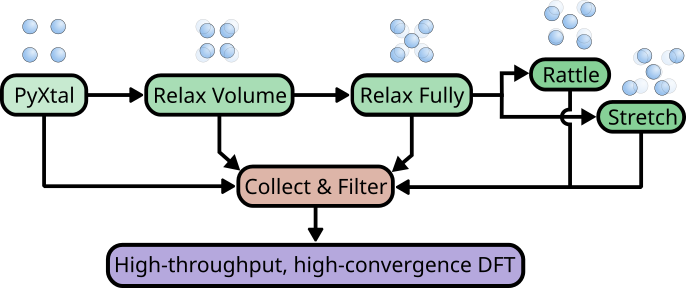
ASSYST workflow steps. Reproduced from Poul et al. under CC-BY 4.0 license.